Table of contents
Comparing men's and women's sports is not a simple side by side. There is a real and measurable physiological gap at the elite level, but it is smaller and more consistent than most people assume, and it is only one part of the story. The faster-moving numbers are commercial and cultural: women's sports are now a multibillion-dollar industry growing at a pace few markets ever see. Here is the data, updated for 2026.
The headline numbers
Four numbers that frame it.
Physiology and performance
The performance gap is real, and consistent.
At the very top of running, the gap between the male and female world record is remarkably stable at roughly 9 to 11 percent. It is largely explained by average differences in lean muscle mass, hemoglobin concentration, cardiac size and stroke volume, maximal oxygen delivery, and the hormonal profile that shapes those characteristics. It widens in explosive events like jumping, where power-to-weight matters more. The key word is averages. These are the records at the extreme tail of human performance, not ceilings on any individual.
How much lower the female world record is than the male, by event. Running events (blue) cluster near 9 percent; explosive jumping events (coral) run wider. Source: World Athletics records.
| Event | Men's record | Women's record | Gap |
|---|---|---|---|
| 100m sprint | 9.58s (Bolt, 2009) | 10.49s (Griffith-Joyner, 1988) | 9.5% |
| Marathon | 1:59:30 (Sawe, 2026) | 2:09:56 (Chepngetich, 2024) | 8.7% |
| High jump | 2.45m (Sotomayor, 1993) | 2.10m (Mahuchikh, 2024) | 14.3% |
| Long jump | 8.95m (Powell, 1991) | 7.52m (Chistyakova, 1988) | 16.0% |
Official world records. In April 2026 Sabastian Sawe ran 1:59:30 in London, the first official marathon under two hours, lowering Kelvin Kiptum's 2:00:35 from 2023.
Participation and commerce
The real story is the growth curve.
While the performance gap holds steady, the commercial side of women's sports is moving faster than almost any market. Global revenue for women's elite sports has roughly quadrupled in four years, crossing the billion-dollar line for the first time in 2024 and on track to top $3 billion in 2026, according to Deloitte.
Global women's elite sports revenue, in US dollars. 2026 is a Deloitte projection. Commercial revenue alone crossed $1 billion for the first time in 2024.
Viewership is following the money, and in one marquee case overtook the men's game outright. The 2024 NCAA women's basketball championship final drew 18.9 million viewers, beating the men's final's 14.8 million for the first time.
US television viewership, 2024 NCAA Division I basketball championship finals.
Health and longevity
Where the injury data diverges.
The most actionable difference is in injury risk. Female athletes tear the ACL far more often than men in the same sports, with most estimates ranging from two to eight times the risk for non-contact tears. This is not about fragility. It traces to specific, well-studied factors that targeted training can address.
Relative risk of a non-contact ACL tear. Published estimates range from roughly two to eight times higher depending on the sport.
Several factors contribute, and the strongest evidence points to neuromuscular control and movement mechanics rather than anatomy alone. On average, female athletes land with less knee flexion and more inward knee collapse, which increases the forces the joint absorbs, and hip and trunk stability play a large role. Anatomical alignment such as a wider hip-to-knee angle (the Q-angle) has been proposed as a contributor, but current evidence suggests it explains only a small portion of the observed risk. Hormonal fluctuations across the menstrual cycle may influence ligament physiology and neuromuscular function, though systematic reviews find the evidence for an independent effect on ACL injury risk to be mixed. Neuromuscular training that drills landing and deceleration measurably lowers the risk, which is why screening and prevention work matters more here than almost anywhere in sports medicine.
Putting the data to work
Averages describe groups, not you.
The practical takeaway is that population averages are a starting point, not a training plan. A male-female gap at the world-record level says nothing about how a given athlete should train. Individual injury risk is multifactorial, depending on sport, previous injury, biomechanics, training load, and neuromuscular control, so population statistics should inform individual decisions rather than determine them. The athletes who get the most out of this kind of data track their own signals over time, energy and recovery across the menstrual cycle, inflammatory markers after hard blocks, sleep and resting heart rate, and adjust based on what their own numbers show rather than a generic template.
Sources: World Athletics (world records); Deloitte (Beyond the Billion-dollar Barrier, women's elite sports revenue); reported NCAA championship television viewership; and peer-reviewed sports-medicine literature on ACL injury risk. Figures are current as of 2026 and rounded. Some marathon and high jump marks are pending final ratification.
Fact Checked
Dr. Mohammed A. Fouda, MD
Dr. Fouda is a Neurosurgery research scholar. His work focus primarily on Brain tumor behavior and quality of life of cancer patients as well as biomedical engineering and medical device innovation.
How OneTwenty Works
Not your average
Checkup.
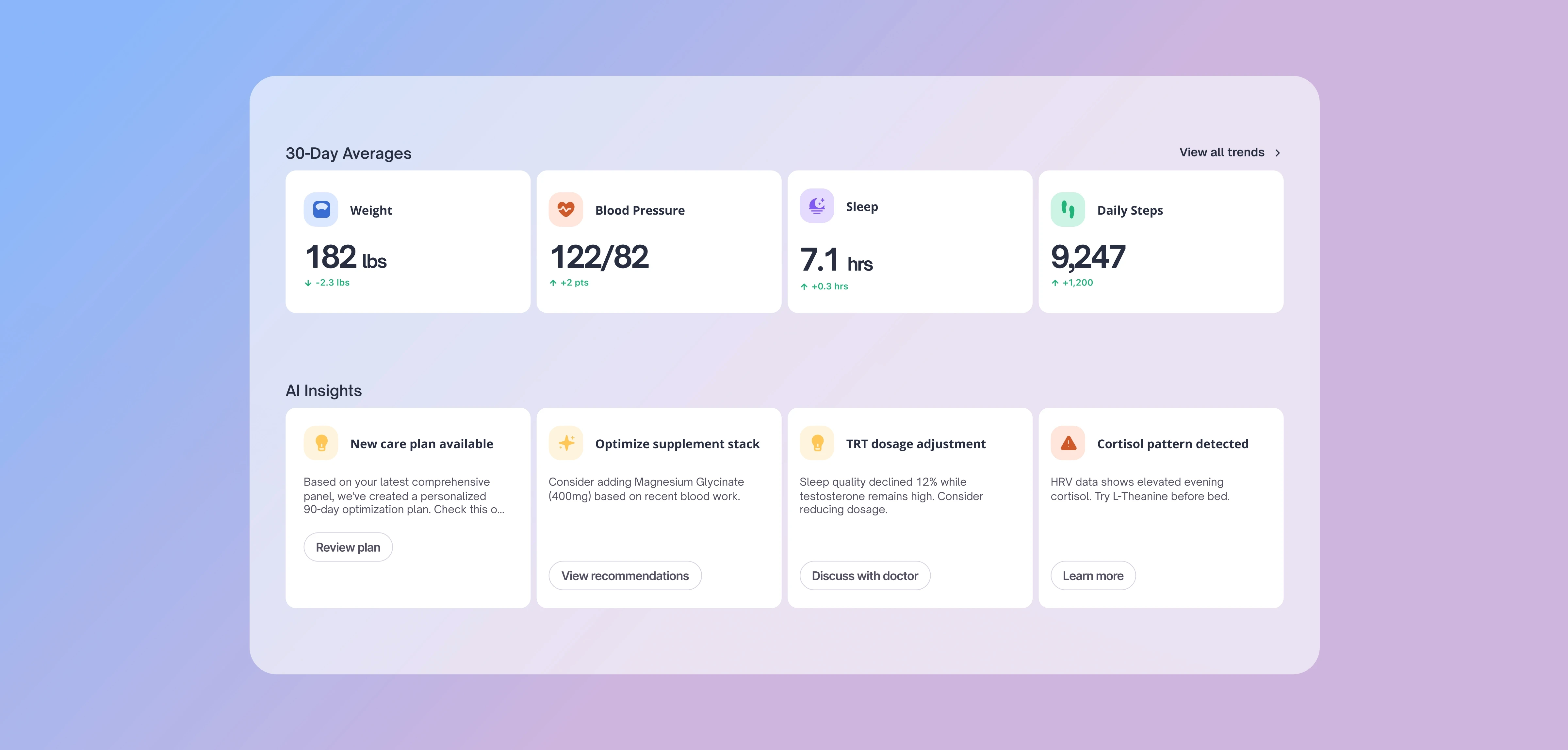
Every life stage brings new biological demands. Tracking the right metrics at the right time helps you adapt, optimize performance, and extend both lifespan and healthspan.
Your Annual Physical
Manual Data Processing
Guesswork Trend Detection
Once-a-year physical
Reactive, tested when sick
No data between visits
Once a year testing
Delayed Results
One-size dosing, set and forget
Real-Time Trend Insights
Daily smart-device data
Automated Data Sync
Quarterly Biomarker Tests
Optimal, personalized targets
Plain-language AI insights
Medications titrated to your data
Built to extend healthspan

Frequently Asked Questions
Clarity before
you commit
Answers on setup, scale, and support to remove blockers.